


Buying a home in 2026 is not just about location, builder reputation, or amenities. It is also deeply connected to economic factors like the repo rate. If you are planning to take a home loan, understanding how repo rate affects your EMI can save you lakhs over time.
What is Repo Rate and Why It Matters in 2026
The repo rate is the interest rate at which the Reserve Bank lends money to commercial banks. In simple terms, when banks need funds, they borrow from the central bank at this rate. Now you might wonder how that affects you.
Here is the connection. When the repo rate changes, banks adjust their lending rates. Since most home loans today are linked to external benchmarks like repo rate, your loan interest directly depends on it.
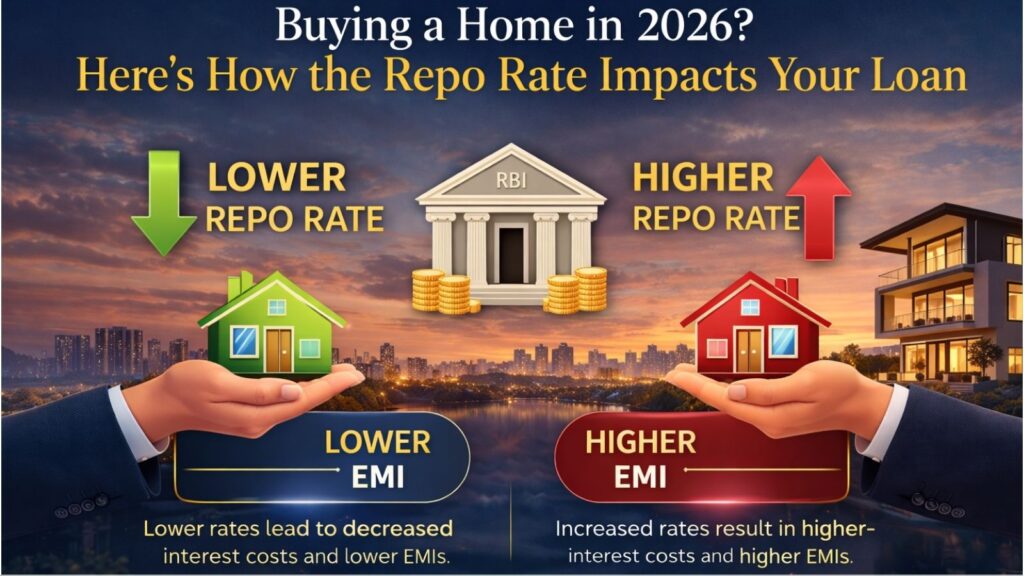
In 2026, repo rate movements are especially important because inflation and economic conditions are constantly changing. If the repo rate goes up, your loan becomes costlier. If it comes down, your EMI reduces.
For a homebuyer, this means timing matters. Buying when rates are lower can make a huge difference in affordability. Many people ignore this factor and only focus on property prices, but interest rates play an equally important role.
Understanding repo rate is like knowing the hidden cost of your home. It does not appear in the property brochure, but it impacts your long-term financial health.
How Repo Rate Directly Affects Your Home Loan EMI
Your EMI or Equated Monthly Installment is directly tied to your loan interest rate. When the repo rate increases, banks increase their lending rates, which leads to higher EMIs.
Let’s say you take a ₹50 lakh loan for 20 years. Even a small increase of 0.5 percent in interest can raise your EMI significantly. Over the full tenure, this could mean paying several lakhs extra.
In 2026, most home loans are repo linked, meaning changes are passed on faster than before. Earlier, banks delayed passing rate changes, but now the impact is almost immediate.
For buyers, this creates both risk and opportunity. If the repo rate drops after you take a loan, your EMI can reduce. But if it increases, your monthly burden rises.
This is why financial planning is crucial. Always calculate your EMI at a slightly higher interest rate than current levels. This gives you a safety cushion.
In simple words, repo rate controls how heavy or light your EMI feels every month.
Fixed vs Floating Interest Rates in 2026
When taking a home loan, you usually choose between fixed and floating interest rates. Repo rate plays a major role in this decision.
A floating rate loan changes with repo rate fluctuations. So if the repo rate increases, your interest rate increases. If it decreases, you benefit.
On the other hand, fixed rates remain constant for a certain period. This gives stability but usually comes at a slightly higher initial rate.
In 2026, floating rates are more popular because they often start lower and allow borrowers to benefit from falling rates. However, they come with uncertainty.
If you expect repo rates to fall in the future, floating is a good option. If you prefer stability and want to avoid surprises, fixed might be better.
Many banks also offer hybrid options which are fixed for a few years and then floating. This is becoming a smart middle-ground choice.
The key is to align your loan type with your financial comfort. Repo rate movements are unpredictable, so choosing wisely can protect your budget.
Impact of Repo Rate on Property Affordability
Repo rate does not just affect your EMI. It directly impacts how much home you can afford.
When interest rates are low, your EMI is lower, which means you can afford a bigger loan amount. This increases your purchasing power.
For example, with a lower interest rate, the same EMI might allow you to buy a 3 BHK instead of a 2 BHK. But when rates rise, your affordability decreases.
In 2026, this becomes even more critical as property prices in cities are already high. A small rate change can shift your budget significantly.
Many buyers make the mistake of stretching their budget when rates are low without considering future increases. This can lead to financial stress later.
Smart buyers look at both current and potential future rates before deciding their budget. Always keep a margin for safety.
Think of repo rate as a factor that decides how wide your home-buying options are.
Timing Your Home Purchase with Repo Rate Trends
Timing your purchase based on repo rate trends can help you save money.
If the repo rate is expected to rise, it is better to lock in a loan earlier. This helps you secure a lower interest rate.
On the other hand, if rates are expected to fall, waiting a little could benefit you. However, timing the market perfectly is difficult.
In 2026, experts suggest focusing on long-term affordability rather than short-term rate movements. Do not delay your purchase endlessly waiting for the perfect rate.
Also, remember that property prices may increase while you wait. So the benefit of a lower interest rate could be offset by a higher property cost.
A balanced approach works best. Track repo trends but do not rely only on them.
Buying a home is a long-term decision, and small timing differences matter less over 20 years compared to overall planning.
How Banks Adjust Home Loan Rates After Repo Changes
When the repo rate changes, banks adjust their lending rates but not always in the same way.
Some banks pass on the change immediately, while others take a few months depending on their reset cycle.
In repo linked loans, the reset period is usually 3 to 6 months. This means your EMI may not change instantly but will adjust during the next reset.
In 2026, transparency has improved, and most banks follow clearer guidelines. However, borrowers should still understand their loan terms.
Always check your loan agreement for reset frequency. This helps you predict when your EMI will change.
Banks may adjust either your EMI or your loan tenure. Some keep EMI constant and increase tenure, while others increase EMI.
Understanding this mechanism helps you stay prepared and avoid surprises.
Repo Rate and Its Effect on Real Estate Demand
Repo rate does not just affect individual buyers. It impacts the entire real estate market.
When rates are low, more people can afford loans, leading to higher demand for homes. This often pushes property prices upward.
When rates rise, demand slows down because loans become expensive. This can stabilize or even reduce property prices.
In 2026, developers and investors closely watch repo rate trends to plan launches and pricing.
For buyers, this means opportunities can arise in both scenarios. High rates may reduce competition, giving you better negotiation power.
Low rates may increase demand, but also increase prices.
Understanding this cycle can help you make smarter decisions and choose the right time to invest.
Strategies to Reduce Impact of Rising Repo Rates
Even if repo rates increase, there are ways to manage your home loan efficiently.
One effective strategy is making partial prepayments whenever possible. This reduces your principal and lowers future interest.
Another option is increasing your EMI slightly when rates rise instead of extending your loan tenure. This helps you save on long-term interest.
You can also consider refinancing your loan if another bank offers better rates.
Maintaining a good credit score is crucial, as it helps you negotiate better interest rates.
In 2026, financial discipline plays a key role in managing loan costs. Small steps can lead to big savings.
Think of it as taking control of your loan instead of letting interest rates control you.
Long-Term Impact of Repo Rate on Total Loan Cost
Many buyers focus only on EMI, but the real impact of repo rate is seen in the total cost of the loan.
A slight increase in interest rate can add lakhs to your total repayment over 20 to 30 years.
For example, even a 1 percent increase in interest can significantly increase your total interest outgo.
This is why it is important to look beyond monthly affordability and consider long-term impact.
In 2026, with longer loan tenures becoming common, this factor becomes even more important.
Always use loan calculators to understand total cost at different interest rates.
Making informed decisions today can save you a huge amount in the future.
Final Tips for Home Buyers in 2026
If you are planning to buy a home in 2026, keep these practical tips in mind.
Do not just focus on property price. Consider interest rates equally. Always plan your budget with a buffer for rate increases.
Choose the right type of loan based on your comfort level. Keep track of repo rate trends but do not delay your purchase unnecessarily.
Maintain a strong financial profile to get better loan terms. Read your loan agreement carefully and understand all clauses.
Most importantly, think long-term. A home loan is a commitment of decades, and small decisions today can have a big impact.
Buying a home is a dream, but managing your loan smartly ensures that the dream does not turn into a financial burden.